How to Evaluate Black Masterbatch Dispersion
Short Answer
Dispersion is judged in the processed plastic, not by looking at pellets. A reliable evaluation combines three things: a laboratory test that matches your process (a film test for film, a filter pressure value test for fine-screen extrusion and fibres, microscopy for pipe and cable compounds), a fair comparison at equal carbon black content in the final part, and a trial on your own production line against acceptance criteria agreed in advance. No single number tells the whole story, and every result is only valid for the equipment, test polymer and conditions used to produce it.
Dispersion vs Distribution
The two terms are often used interchangeably, but they describe different problems:
| Term | What it describes | Typical symptom when it fails |
|---|---|---|
| Dispersion | How completely carbon black agglomerates are broken down and wetted by the polymer | Hard black specks, gels, rough surface, blocked screens |
| Distribution | How evenly the dispersed carbon black is spread through the part | Streaks, colour bands, uneven blackness or opacity |
Dispersion is set mainly when the masterbatch is made: agglomerates that leave the masterbatch line intact rarely break down in a converter's single-screw extruder. Distribution depends more on the converting process: let-down ratio, screw mixing, dosing accuracy and how well the carrier's melt viscosity matches the base resin. Separating the two is the first step in finding the real cause of a defect.
Method 1: Film Test (ISO 23900-6:2015)
ISO 23900-6:2015 describes a film test for assessing how well pigments or extenders are dispersed in a thermoplastic polymer. It applies to concentrates and compounds processed into blown or cast film. The concentrate is diluted in a test polymer and extruded into film, and the specks caused by undispersed colorant are assessed.
Thin film shows agglomerates as specks, which makes the film test well suited to blown film, cast film and other thin-gauge products. How much it detects still depends on sample preparation, film thickness, dilution, test polymer, and the inspection method and its resolution, so two results can only be compared when these conditions are the same. The standard also places general film defects such as gels, black specks and holes outside its scope: it rates colorant dispersion, not overall film quality. Defects found in production are a separate troubleshooting question, covered below.
Method 2: Filter Pressure Value (ISO 23900-5:2015)
ISO 23900-5:2015 determines the filter pressure value (FPV). A colour concentrate in a test polymer is extruded through a defined screen pack, and the melt pressure in front of the screen is recorded. The FPV relates the pressure rise to the amount of colorant tested: FPV = (pmax − ps) / mc, in bar/g, where ps is the start pressure, pmax the maximum pressure and mc the mass of colorant used in the test, not the total mass of the masterbatch sample. Undispersed agglomerates collect on the screen and push the pressure up, so under the same conditions a lower FPV means fewer screen-blocking particles.
FPV matters most where the melt passes through fine filters: fibres, melt spinning, thin film and other lines with fine screen packs. The standard states that an FPV is valid only for the equipment, conditions and test polymer used, and that results for different colorants are comparable only when the colour concentrates are prepared the same way, so FPV figures from different laboratories, screens or test recipes cannot be compared directly. When a supplier quotes an FPV, ask for the screen mesh, pigment concentration, throughput and test polymer behind it.
Method 3: Microscopy and ISO 18553:2025
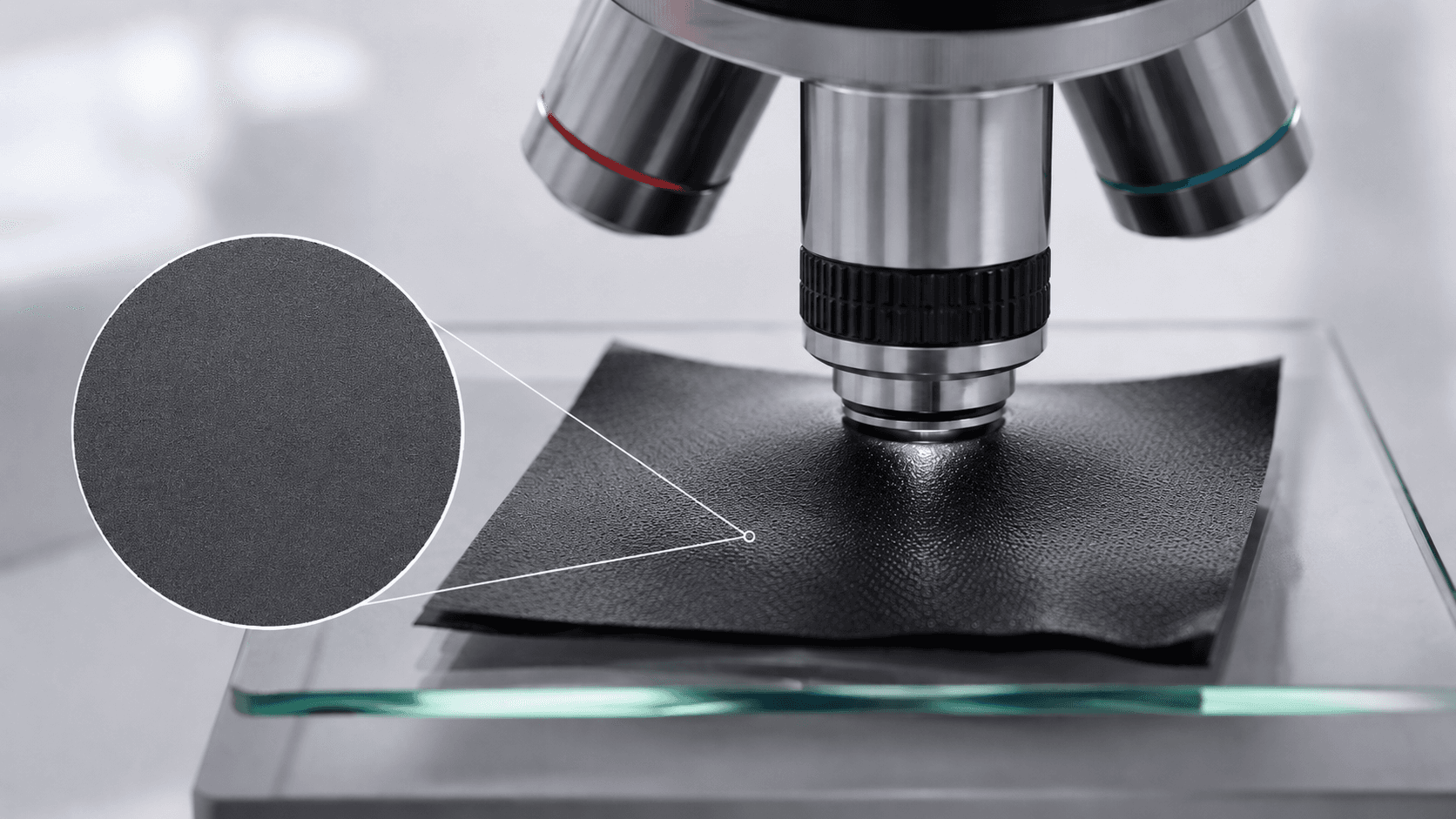
Microscopy looks at dispersion directly. Thin sections, cut with a microtome or pressed between microscope slides, are examined under magnification; particle and agglomerate sizes are graded, and the overall appearance is compared with reference images.
ISO 18553:2025, which replaced the 2002 edition, is the microscopy method referenced by ISO and EN standards for polyolefin pipes and fittings. Under the conditions it specifies, it covers polyolefin pipes, fittings and compounds, including raw material in pellet form, with an important limit: less than 3% carbon black (or less than 5% pigment) by weight. It therefore applies to the let-down compound, compound pellets or the finished pipe, not to a concentrated masterbatch with 30–50% carbon black, and it cannot be used to claim that such a masterbatch has passed or is certified to ISO 18553. Read any result together with the pipe or fitting standard that calls for it.
For cable jacketing, sheet and injection-moulded parts, microscopy of a pressed or microtomed sample from the real part is still useful, but acceptance limits should be agreed between buyer and supplier rather than borrowed from a pipe standard.
Which Method Fits Your Application
| Your application | Most relevant check | What it shows |
|---|---|---|
| Blown or cast film, thin sheet | Film test (ISO 23900-6) | Specks from undispersed colorant in a test film |
| Fibres, fine-screen extrusion | Filter pressure value (ISO 23900-5) | Agglomerates that block screens |
| Polyolefin pipe and fittings | ISO 18553 microscopy on the compound or pipe | Agglomerate size and appearance rating |
| Cable jacketing, moulded parts | Microscopy plus a production trial | Agglomerates and surface defects in the real part |
How to Compare Two Masterbatches Fairly
A common mistake is to run a 40% and a 50% carbon black masterbatch at the same let-down ratio. The higher-loaded sample puts more carbon black into the part, so it looks blacker and may also show more specks, and neither result says anything about dispersion quality. For a fair comparison:
- Match the carbon black content in the final part, not the dosing rate. For example, 1.0% carbon black in the part needs 2.5% of a 40% masterbatch but only 2.0% of a 50% masterbatch (illustrative arithmetic, not a dosing recommendation).
- Use the same base resin lot, machine, screw, temperature profile, screen pack and output rate for both samples.
- Condition both samples the same way and run them back to back on the same day.
- Produce the same part thickness and judge blackness and defects under the same lighting.
- Note the melt pressure in front of the screen pack at the start and end of each run as a simple in-line indicator.
- Test enough material: a few grams of film or a single plaque can miss rare agglomerates.
Specks, Streaks or Film Defects: Finding the Real Cause
Not every black defect is a dispersion problem, and the standardised dispersion tests above are not designed to diagnose general production defects such as gels or holes. Before rejecting a masterbatch lot, check which pattern the defect follows:
| Symptom | Possible masterbatch cause | Possible process or material cause |
|---|---|---|
| Hard black specks of similar size | Undispersed carbon black agglomerates | Contamination, degraded material from dead spots |
| Streaks or colour bands | Carrier melt viscosity far from the base resin | Poor screw mixing, unstable dosing, short residence time |
| Gels or fish eyes in film | Carrier or additive incompatibility | Gels in the base resin, overheated or crosslinked material |
| Bubbles, voids or splay | Moisture absorbed during storage | Insufficient drying, humid storage of the base resin |
| Defects only after a change | New masterbatch lot | New screen pack, new resin lot or new machine settings |
A useful rule: if the defect also appears with the base resin alone, or with a previously approved masterbatch lot under the same settings, the masterbatch is unlikely to be the root cause. If it appears with only one masterbatch lot, keep samples and compare that lot with the last approved lot on the same line.
Setting Acceptance Criteria with Your Supplier
Dispersion is easiest to manage when buyer and supplier agree in writing what "acceptable" means before the first order. A practical specification records:
- The test method (film test, FPV, microscopy, or an in-house film or plaque check) and its key conditions.
- The base resin and let-down ratio used for testing.
- The acceptance limit or reference sample, such as a maximum speck count per area or an approved appearance standard.
- The sampling plan: which lots are tested and how many samples are taken per lot.
- How results are reported, for example on the certificate of analysis or a test record.
The right limits depend on the product: a thin agricultural film and a thick pipe wall need very different thresholds, so set them from your own trials rather than copying another product's values.
What to Record During a Sample Trial
Keep every trial traceable so the result can be repeated or investigated later:
- Masterbatch grade, lot number and carbon black content as stated on the supplier's documents.
- Base resin grade and lot, let-down ratio and the calculated carbon black content in the part.
- Machine, screw type, temperature profile, screen pack, output rate and melt pressure.
- Product thickness, defect counts or ratings, and blackness or opacity readings if measured.
- Photos taken under consistent lighting, plus retained samples of both the pellets and the finished product.
Frequently Asked Questions
Can dispersion be judged by looking at the pellets?
No. Pellets can look identical yet disperse very differently. Dispersion has to be assessed in a processed sample: film, a pressed or microtomed section, or the actual part.
Is a lower filter pressure value always better?
Under identical test conditions, a lower FPV (pressure rise per gram of colorant) indicates fewer screen-blocking agglomerates. FPVs measured with different screens, test polymers or concentrate preparation cannot be compared with each other.
Does ISO 18553 apply to black masterbatch itself?
ISO 18553:2025 covers polyolefin pipes, fittings and compounds, including pellet-form raw material, with less than 3% carbon black by weight. It applies to the let-down compound or the finished pipe, not to a 30–50% carbon black masterbatch.
Why does a masterbatch disperse well on one line but not on another?
Shear, residence time, screw design, screen packs and melt temperature differ from line to line. A grade that performs well on a long, high-shear line may need a higher-dispersion grade on a short single-screw film line, which is why the final check is always a trial on your own equipment.
What information helps a supplier recommend a grade?
Your base resin and grade, process (film, pipe, cable or injection), product thickness, current let-down ratio, photos of the defects you see, and any dispersion test or acceptance standard your own customer requires.
Related Guides
- Common testing methods for black masterbatch
- High-dispersion vs standard black masterbatch
- What causes crystal spots in blown film
- How to solve streaks in injection-molded black parts
- Controlling blackness and dispersion in pipe extrusion
- Carbon black particle size and structure in masterbatch
Talk to a ZFH Engineer
ZFH offers standard PE/EVA black masterbatch, PP black masterbatch and cable masterbatch in grades with different carbon black contents and carriers. If you are comparing grades or investigating a dispersion problem, contact our engineers with your base resin, process and defect photos. We can suggest grades to trial and confirm what test documentation can be provided for the grade you select.