Carbon Black in Masterbatch: Particle Size, Structure, Surface Area and Other Data Sheet Properties
Why the Carbon Black Matters as Much as the Percentage
Two masterbatches with the same carbon black content can differ in jetness, dispersion, viscosity, UV protection and conductivity because they use different carbon blacks. The properties that explain those differences are measured by standardized tests and appear on carbon black data sheets. This article explains what each property means for a masterbatch. How particle size drives blackness and opacity in the finished part is covered separately in how carbon black particle size affects blackness and opacity.
The Properties at a Glance
| Property | What it describes | Common test method | Main effect in masterbatch |
|---|---|---|---|
| Primary particle size | Diameter of the smallest particles | ASTM D3849 (electron microscopy) | Jetness, tint, UV absorption, ease of dispersion |
| Surface area | Area available per gram, linked to particle size | ASTM D6556 (nitrogen adsorption), ASTM D1510 (iodine number) | Jetness, viscosity, dispersing effort |
| Structure | Branching of aggregates and the voids between them | ASTM D2414 (oil absorption number, OAN) | Viscosity, dispersibility, conductivity |
| Tint strength | Darkening power in a reference white mix | ASTM D3265 | Relative color strength |
| Volatile content | Material driven off on heating, often surface oxygen groups | Supplier method or ISO/ASTM heating methods | Wetting, color development, moisture pickup |
| Ash and impurities | Inorganic residue and grit | ASTM D1506 (ash) and sieve residue methods | Specks, screen blockage, filtration |
Particle Size and Surface Area
Finer carbon blacks have more surface area per gram. They absorb light more effectively, so they give deeper black and higher tint, and they are more effective UV absorbers. The cost is dispersion: finer particles cling together more strongly and raise melt viscosity, so they need more dispersing energy, which is why high-jetness grades place higher demands on compounding. Coarser blacks are easier to disperse and cheaper, but give less depth of black. Surface area is measured by nitrogen adsorption (ASTM D6556 reports total and external surface area) or estimated by the iodine number (ASTM D1510).
Structure
Primary particles fuse into aggregates of different shapes. Highly branched, high-structure aggregates trap more void volume, which is measured as oil absorption number under ASTM D2414. In a masterbatch, higher structure tends to increase viscosity and generally makes the black easier to disperse, while lower structure can allow higher jetness and gloss in pigment applications. Structure is also the key property for conductivity: branched aggregates touch each other at lower loadings and form a conductive network. That is why conductive grades use high-structure blacks and pigment grades usually do not.
Surface Chemistry, Volatiles and Moisture
Carbon black surfaces carry oxygen-containing groups, especially on oxidized pigment blacks. These groups, reported as volatile content, can improve wetting and color development in some systems, but they also attract moisture. Moisture in carbon black or masterbatch can cause bubbles, splay or porosity in processing, so storage and drying matter for grades and carriers that pick up water. Surface chemistry can also affect how carbon black interacts with additives and, in rubber, with cure.
Ash, Grit and Cleanliness
Inorganic residue (ash) and hard particles (grit) do not disperse. In thin film, fibers and fine filtration they show up as specks, holes and rising screen pressure. Virgin furnace blacks normally have low ash; recovered carbon black from tires has much more, which is one reason its use needs closer control. For demanding applications, ask for ash and sieve residue values and the methods behind them.
Matching Properties to the Application
| Requirement | Carbon black direction | Trade-off to manage |
|---|---|---|
| Deep jet black on visible parts | Fine particle size, lower structure | Harder to disperse; needs strong compounding |
| Opacity in thin film | Efficient black with good dispersion | Dispersion quality at thin gauge |
| UV protection outdoors | Fine particle size at an adequate content, well dispersed | Content and dispersion set by the product standard |
| Conductivity or antistatic | High structure, high surface area | Higher loadings, viscosity, sensitivity to processing |
| Economy in thick parts | Coarser, easy-dispersing black | Less depth of black |
How to Read a Masterbatch Supplier's Information
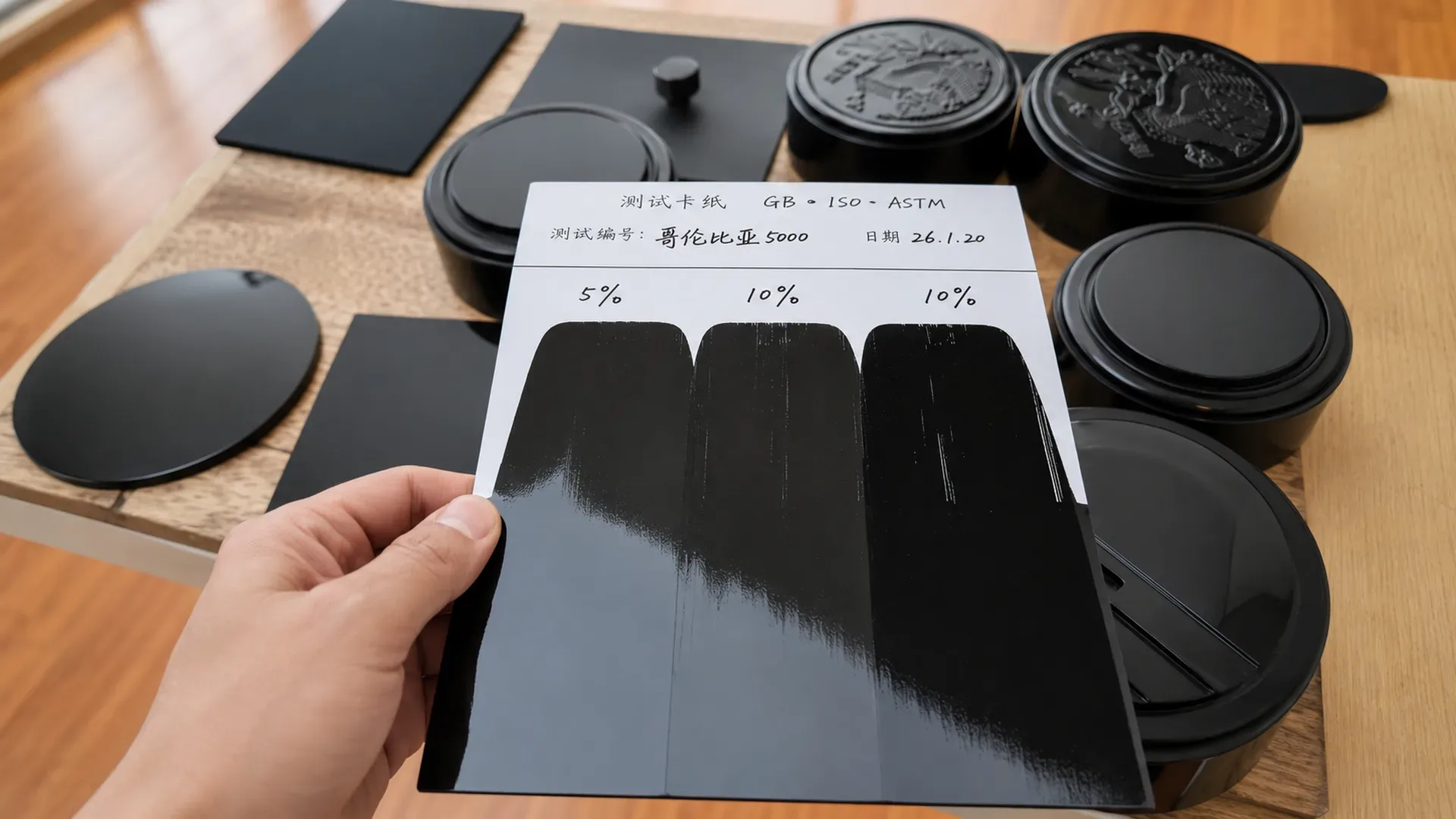
Masterbatch TDSs usually state the carbon black content and type rather than every carbon black property. If your application is sensitive, ask which carbon black family is used (for example a pigment black or a furnace grade), which properties are controlled, and how the masterbatch's dispersion is tested. Carbon black grade names from the rubber industry are explained in how to read carbon black ASTM N-numbers, and the production routes behind different blacks in how carbon black is made.
Frequently Asked Questions
What is the difference between particle size and structure?
Particle size is the diameter of the primary particles; structure is how those particles are fused into branched aggregates. Particle size mainly drives jetness and UV absorption; structure mainly drives viscosity, dispersion behavior and conductivity.
Why are conductive blacks different from pigment blacks?
Conductive applications need high-structure, high-surface-area blacks that form a connected network at practical loadings. Pigment blacks are optimized for color and dispersion instead.
Do I need all these values for an ordinary black part?
Usually not. For general parts, the masterbatch TDS, a trial and an agreed dispersion check are enough. The detailed properties matter for thin film, fibers, conductive parts and premium appearance.
Next Step
Tell us your resin, process and what the black must achieve, and contact ZFH for a grade proposal. For deep-black parts, see high color black masterbatch; for general uses, standard PE/EVA black masterbatch.