How Carbon Black Is Made: Furnace, Channel/Gas, and Thermal Processes — and What Each One Means for Your Black
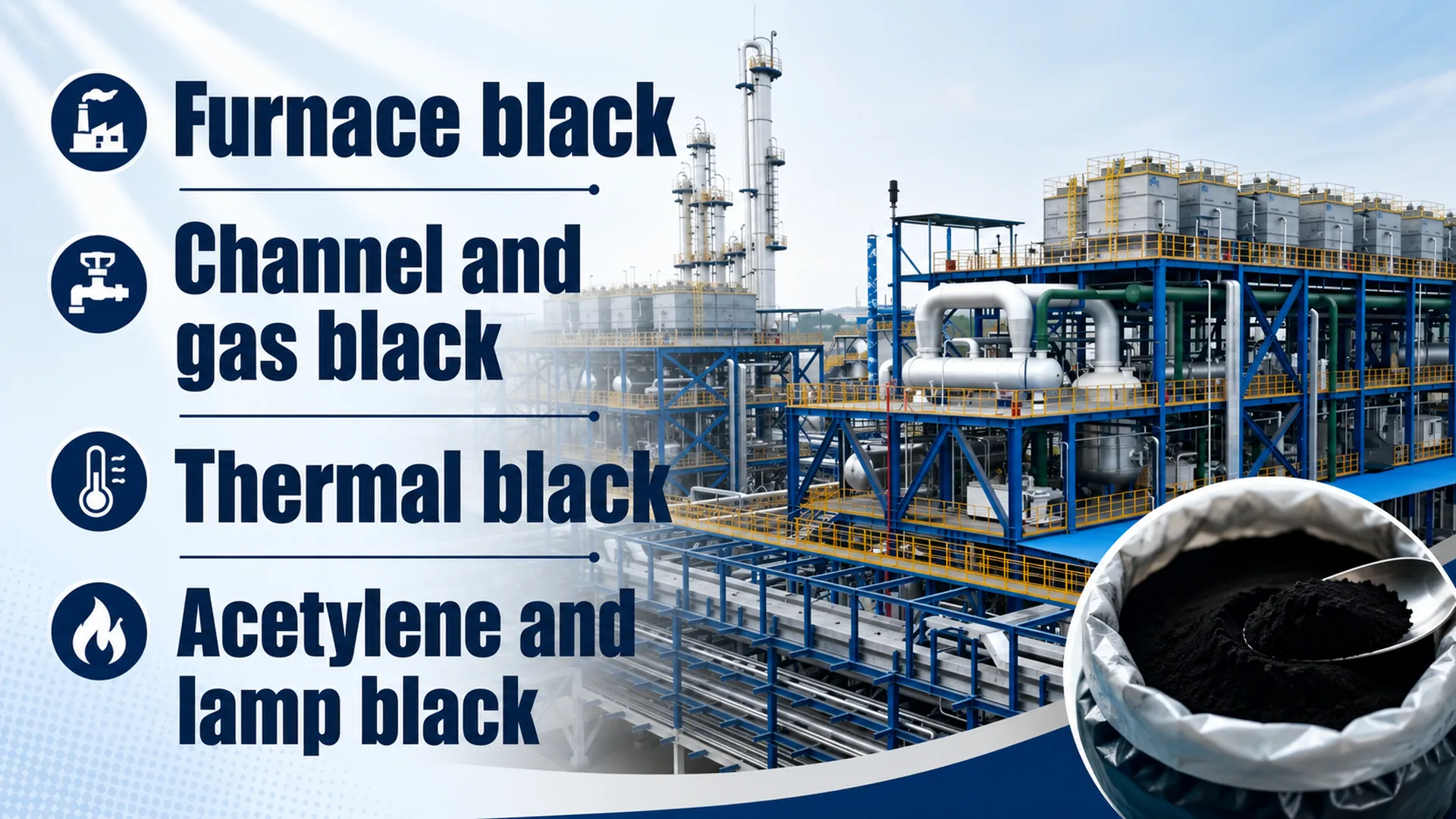
Two black masterbatches can start from carbon blacks that look identical on paper — same particle size, same loading — yet behave differently in jetness, dispersion, and cure. Part of the reason is where the carbon black came from. The process used to make a carbon black sets its basic DNA: how small the particles are, how branched the aggregates are, what sits on the particle surface, and how clean it is. This article walks through the main production routes — furnace, channel and gas, thermal, and the niche acetylene and lamp processes — and explains how each route shapes the black you eventually buy.
The Short Answer
The furnace process makes the great majority of the world's carbon black; it is highly controllable and covers a wide span of grades, and it is what most rubber and plastics blacks are made by. The channel process once made the finest, deepest-color blacks but has been almost entirely phased out; the gas black process replaced it for fine pigment blacks used in plastics and coatings. The thermal process makes the coarsest, cleanest, lowest-structure blacks, used as high-loading fillers. Acetylene and lamp black are niche routes for conductivity and specialty pigments. Knowing the route tells you, before you read a single number, roughly what kind of black you are dealing with.
Furnace Black: The Workhorse
In the furnace process, a heavy aromatic feedstock — typically a residue from petroleum distillation or cracking — is injected into a closed reactor and partially combusted and pyrolyzed at high temperature under tightly controlled conditions. By adjusting feedstock, temperature, air ratio, and residence time, producers can dial in a wide range of primary particle sizes, aggregate structures, and surface chemistries in one process. That controllability, together with high throughput and cost efficiency, is why the furnace route accounts for roughly 80–90% of world production and supplies most of the carbon black used in tires, rubber goods, plastics, and coatings. Its practical limit is at the very fine, very deep-color end: it is difficult to push the furnace process to the ultra-fine particle sizes that the deepest jet pigment blacks require.
Channel and Gas Black: The Fine Pigment Blacks
The channel process burned small natural-gas flames in open air against cooled iron channels and scraped off the deposited soot. It produced ultra-fine particles with an oxidized, slightly acidic surface — which gives very deep color and, in rubber, a slow cure (the S in the ASTM naming covered in our guide to reading N-numbers). But its yield was low and its emissions high, and rising gas prices and air-quality rules pushed it almost entirely out of use.
Its successor for fine pigment blacks is the gas black process, in which flames fed with vaporized oil burn against cooled rolls with free air access; the black is collected from the rolls and from filters. Gas blacks reproduce the deep color range of channel blacks and are a mainstay of high-jetness blacks for plastics, inks, and coatings. Their oxidized surface aids wetting and color development, though it also means somewhat higher extractable content than the old channel blacks.
Thermal Black: The Coarse Specialist
The thermal process is different in kind: natural gas is thermally decomposed in the absence of air, in a cyclic furnace where one chamber is heated while another cracks the gas. With no combustion, it yields the coarsest carbon blacks of all — the largest primary particles (up to several hundred nanometers), the lowest structure, very low surface area, and high purity. These are the N9xx grades. They give poor jetness and little reinforcement, but their large, near-spherical particles are easy to incorporate at very high loadings, which makes them useful as fillers and in specialty rubber and insulation. Thermal black is roughly the other 10% of production alongside furnace black.
Acetylene and Lamp Black: The Niche Routes
Two smaller routes round out the picture. The acetylene black process decomposes acetylene in a self-sustaining exothermic reaction, producing a very pure, high-structure black with high electrical conductivity — the reason it shows up in batteries, conductive polymers, and conductive coatings. The lamp black process, the oldest of all, burns oil in shallow pans with a smoky flame to make a coarse black used historically as a tinting pigment. Neither is a volume route for plastics masterbatch, but both explain grades you may encounter for specific functional jobs.
Why the Process Matters: The Four Levers
Everything above comes down to four properties that the process sets, and that then decide how a black performs. Particle size: smaller particles give deeper blackness and better UV protection, but are harder to disperse because finer blacks cling together more strongly. Structure: more branched, higher-structure aggregates disperse more easily and conduct better, but tend to lower peak jetness — which is why structure is read separately, from the oil-absorption value. Surface chemistry: an oxidized surface (channel and gas blacks) deepens color and slows rubber cure, while cleaner furnace surfaces behave more neutrally. Purity: thermal and acetylene blacks are very clean, while some routes carry more residual extractables. Read the process first, and the datasheet numbers start to make sense as a set rather than as isolated figures.
What This Means for Your Masterbatch
For black masterbatch, the process behind the carbon black quietly sets your ceiling. A fine, oxidized-surface pigment black can reach jetness a furnace-reinforcing grade never will — but it demands more dispersive work to break down, which is exactly where compounding quality decides the outcome. A coarser furnace or thermal black disperses easily and loads cheaply, but will not hit deep-jet targets. There is no single best carbon black, only the right process-and-grade for the job, compounded so that even the hard, fine blacks let down cleanly.
ZFH selects carbon black by the demands of the application — finer pigment-grade blacks where jetness and weathering matter, more economical furnace grades where opacity and cost lead — and treats dispersion as a controlled quality attribute, so that the black's inherent potential actually shows up in your part.
Frequently Asked Questions
Is furnace black lower quality than channel or gas black?
No — it is different, not lower. Furnace black is the most versatile route and covers most grades; channel and gas blacks specialize in the very fine, deep-color end. Better depends on whether you are chasing jetness, cost, or reinforcement.
Why can't the furnace process just make the deepest jet blacks?
It struggles to reach the ultra-fine particle sizes those blacks need while keeping a tight particle-size distribution. That very-fine, deep-color niche is where gas blacks (and historically channel blacks) still lead.
Which process does my masterbatch use?
Most black masterbatch uses furnace blacks, with finer pigment (often gas-process) blacks where high jetness is required. Ask your supplier about particle size, structure (OAN), and dispersion rather than the process name alone.
Sources
The process descriptions and production shares in this article draw on public industry references, including the US EPA AP-42 process description for carbon black (oil-furnace and thermal processes) and standard carbon black production literature; the furnace share of roughly 80–90% and the thermal share of about 10% reflect commonly reported figures that vary by region and year. The link between surface oxidation, the N/S cure-rate designation, and particle-size classification follows ASTM D1765. Structure is measured by oil absorption (OAN/DBP, ASTM D2414) and surface area by nitrogen adsorption (ASTM D6556). Grade behavior described here is general industry knowledge, not a claim about any specific supplier's product.
The production route is the first clue to what a carbon black can and cannot do — and dispersion is what lets that potential reach your part. To see how we translate carbon black selection into consistent black, compare ZFH high color black masterbatch and standard PE/EVA black masterbatch, read our companion guide on reading carbon black N-numbers, or ask about our characterization on the quality and compliance page.