Black Masterbatch Explained: Composition, Manufacturing, Grades and How to Specify It

Who This Guide Is For
This guide is for buyers, product engineers and quality staff who need to specify black masterbatch, compare offers or qualify a new supplier. For a short definition and glossary, start with what carbon black masterbatch is; this article goes further into how the material is made, how grades differ and what to put in a specification.
Composition: Four Decisions in One Pellet
- Carbon black grade. Particle size, structure and surface chemistry decide jetness, undertone, dispersibility and UV absorption. Fine pigment blacks give deeper black but need more dispersing work.
- Carbon black content. The concentration in the masterbatch, which, together with the addition rate, sets the content in the finished part.
- Carrier resin. It must melt and mix into the customer's resin without harming its processing or properties; PE and EVA carriers suit polyolefins, while engineering resins need matched carriers.
- Additives and fillers. Dispersing aids and waxes help wetting; antioxidants protect the melt; some grades contain mineral fillers to lower cost.
None of these alone determines quality. Two grades with the same carbon black content can perform very differently if their carbon black, carrier or dispersion differ.
How Black Masterbatch Is Manufactured
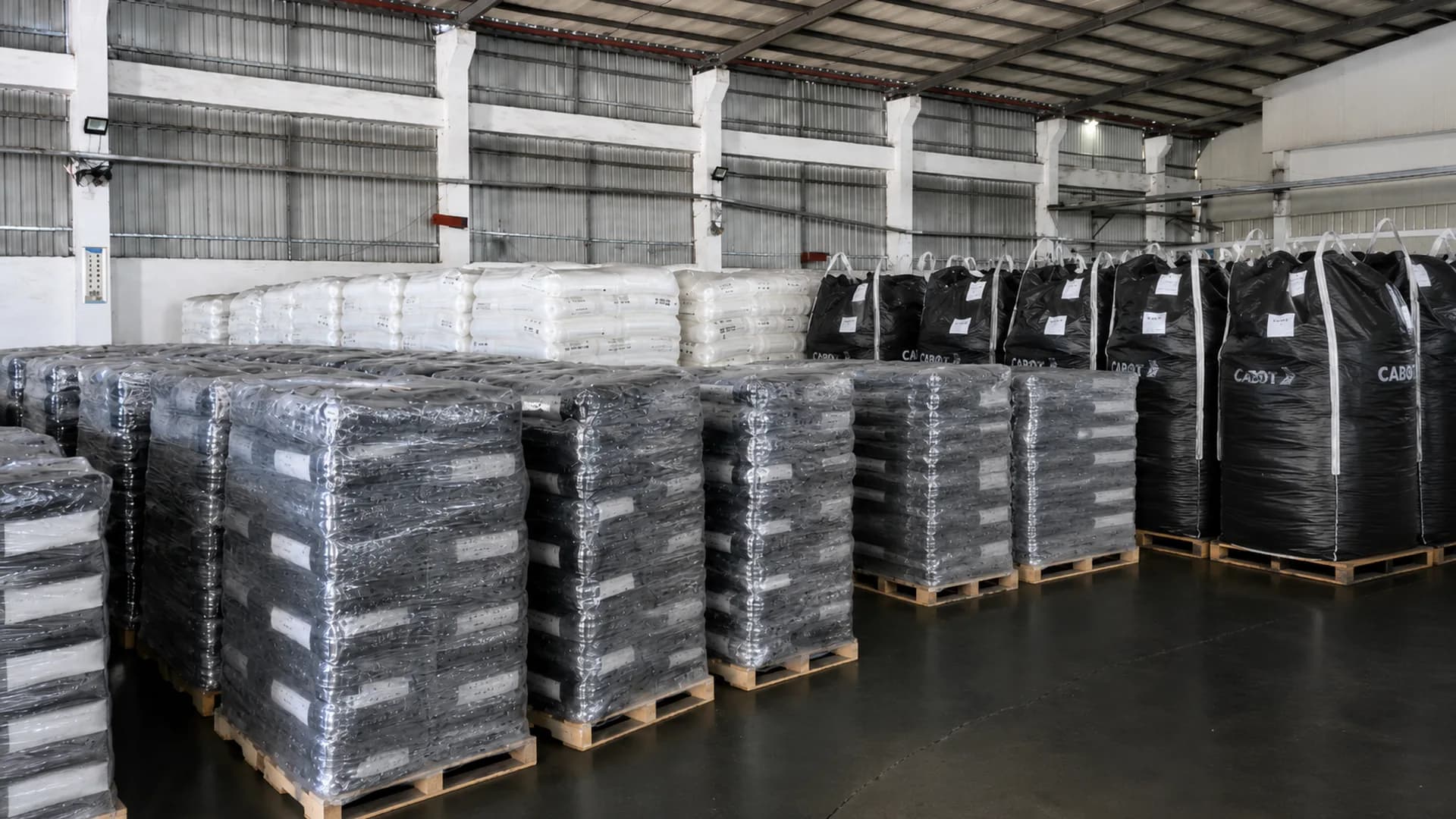
- Raw material selection. Carbon black, carrier and additives are chosen for the target resin and end use.
- Premixing. The components are blended so that the extruder receives a uniform feed.
- Compounding. On a twin-screw extruder, shear, melt temperature and residence time break down carbon black agglomerates and wet them with the carrier. This step largely determines dispersion. ZFH uses two-stage co-rotating twin-screw extrusion for its black masterbatch.
- Pelletizing and quality control. Strands are cooled and cut, and each lot is checked against its specification, for example for carbon black content, melt flow and dispersion, before packing.


What Black Masterbatch Does in the Finished Part
- Color and opacity: a small amount of well-dispersed carbon black gives deep black and blocks light.
- UV protection: carbon black absorbs UV radiation and is widely used to protect polyolefins outdoors. How long a product lasts depends on the carbon black type, content and dispersion, the polymer, the stabilizers and the exposure, and is set by testing and by the product standard, not by the masterbatch alone.
- Clean handling and consistency: pellets replace dusty powder and dose like resin.
A note on mechanical properties: in rubber, carbon black is a reinforcing filler, but at the low levels used for coloring thermoplastics it is not a reinforcement. A well-dispersed masterbatch with a compatible carrier should have little effect on properties; poor dispersion, an unsuitable carrier or high filler content can reduce impact strength or elongation. Check the properties that matter on the finished part.
Grade Types
The table summarizes the black grades on ZFH's product pages. Carbon black ranges are the ranges published for each product family; a specific grade has one value on its TDS.
| Grade family | Carbon black content | Carrier | Typical uses |
|---|---|---|---|
| Standard PE/EVA black | 30–50% | LDPE / LLDPE / EVA | Blown and cast film, molding, pipe and cable |
| PP black | 14% | PP | PP injection molding and extrusion |
| rPE recycled black | 10–49% | Recycled PE | Bags, general molding, cost-sensitive uses |
| High jetness / high color black | 15–49% | Matched to the resin | Visible parts needing deep black |
| Engineering plastics black | 20–40% | SAN / PC / PA / ABS / POM | Housings, automotive interiors, technical parts |
| Y-Series sustainable black | 8–46% | rPE + rEVA | Courier and refuse bags, construction film |
Details are on the masterbatch products page. Filler-free or filled? Filler-free grades contain only carbon black, carrier and processing additives and suit engineering resins, thin film and parts with strict mechanical requirements. Filled grades lower cost in thicker, less demanding products.
How to Specify a Black Masterbatch
| Specification item | Why it matters | How to confirm |
|---|---|---|
| Base resin and process | Determines the carrier and processing window | Name the resin grade, process and temperature range |
| Carbon black content and addition rate | Sets the carbon black in the part and the cost | Calculate the content in the part; confirm in trial |
| Jetness or opacity target | Defines what "black enough" means | Approved reference sample; L* or light transmission where needed |
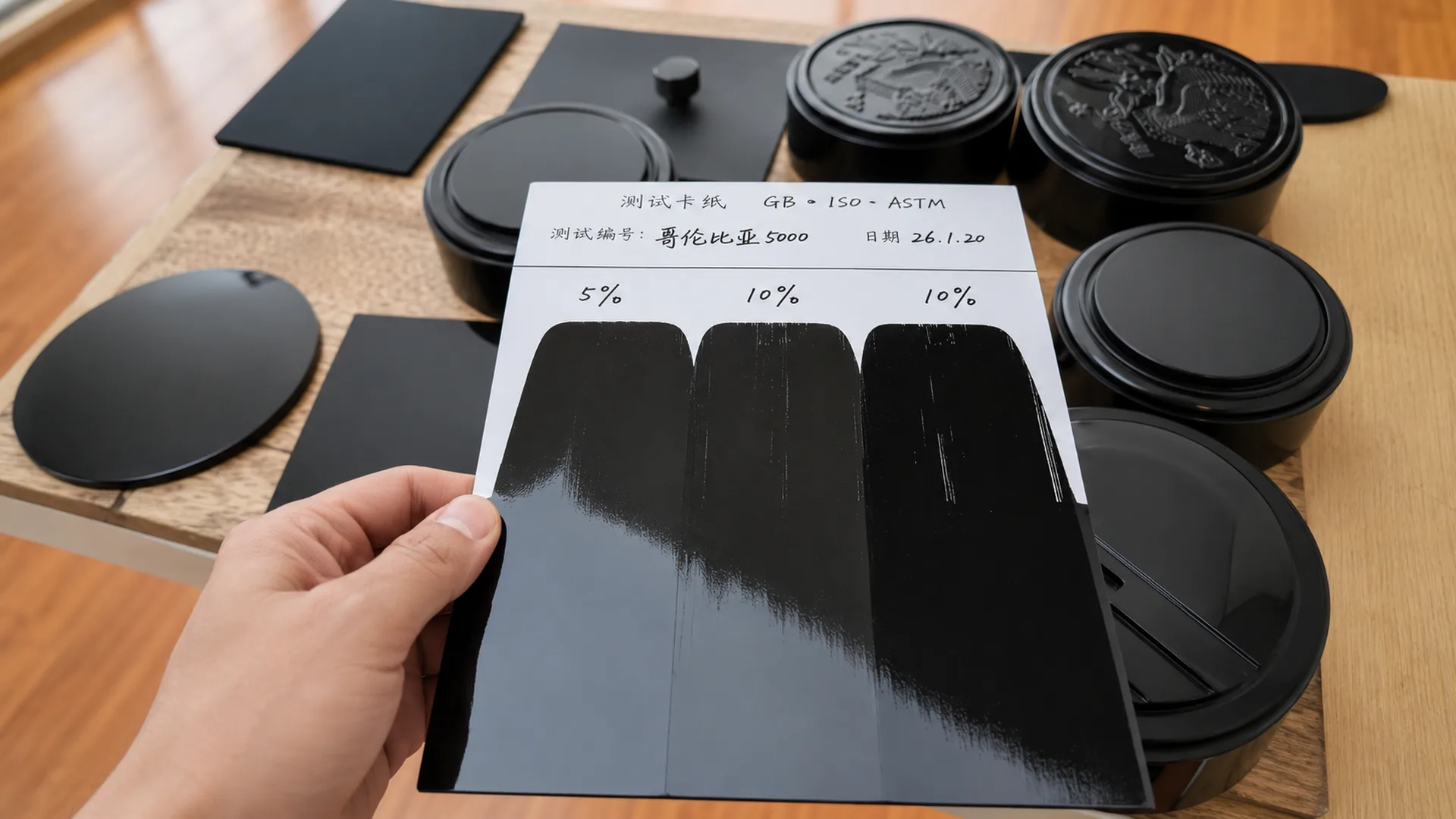
| Dispersion requirement | Avoids specks, holes and screen blockage | Agreed test method and limit, or a reference sample |
| Filler | Affects mechanical properties and thin walls | State filler-free if required |
| UV or outdoor use | Needs a suitable carbon black and level | Product standard requirements and testing |
| Documents | Regulatory and customer requirements | Reports tied to the specific grade |
Documents to Request
Which documents are needed depends on the product and market, and each answers a different question. RoHS test reports cover restricted substances in electrical and electronic equipment (Directive 2011/65/EU as amended by (EU) 2015/863), REACH SVHC screening covers substances of very high concern, and EN 71-3:2019+A2:2024 covers element migration for toys. Food-contact compliance is a separate question governed by the rules of each market: FDA does not issue one general certificate for all masterbatches, and the applicable regulations, tests and declarations differ between markets. Where food contact is intended, the supplier should provide supporting documents for the specific grade, formulation and scope of use, and the finished article still needs its own evaluation. Each report applies to the grade, sample and scope named on it. How to read such reports is covered in how to verify recycled black masterbatch compliance, and the reports available for ZFH grades are listed on the quality and compliance page.
Frequently Asked Questions
What addition rate is typical?
Most black grades are used at a few percent; across ZFH's black range the recommended rate is mostly 1–4%. The right rate depends on the carbon black content, the wall thickness and the target.
Is a higher carbon black content always better?
No. It lowers the addition rate, but blackness also depends on the carbon black grade and dispersion, and very high loadings are harder to disperse. See why higher carbon black content does not always mean higher blackness.
Can black masterbatch be used with recycled plastic?
Yes, with attention to the recycled material's color, contamination and variability; see how to choose black masterbatch for recycled plastics.
Next Steps
Use the grade finder to narrow down a starting grade, read how to choose a black masterbatch supplier before comparing offers, or request a TDS and sample for a trial on your line.